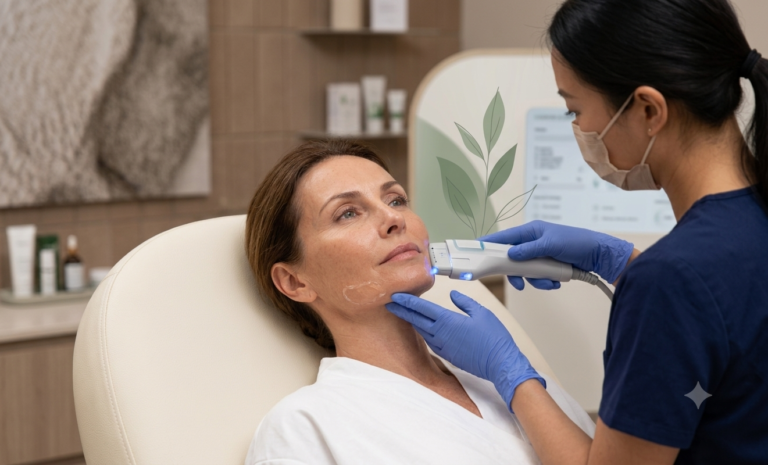
HIFU vs Surgical Facelift — Which Is Right for You?
HIFU and a surgical facelift both target the same structural layer of the face — but they are very different interventions. Here is an honest comparison to help you decide.
One of the questions we hear most often at Radiant Skin House is some variation of: “Is HIFU as good as a facelift?” The honest answer is: it depends what you mean by “as good” — and it depends entirely on your degree of skin laxity, your expectations, and what matters most to you.
This guide gives you the real comparison — not the version that sells you whichever treatment the clinic happens to offer.
What HIFU and a surgical facelift have in common
Both treatments target the SMAS — the Superficial Muscular Aponeurotic System. This is the foundational structural layer of the face that lies beneath the skin and subcutaneous fat. It is the tissue that gives the face its contour and, as it gradually loosens with age, is the primary cause of jowling, a softening jawline, and a drooping neck.
A surgical facelift directly cuts, repositions, and sutures this tissue. HIFU uses focused ultrasound energy to heat it to a precise temperature — causing immediate thermal contraction of the existing collagen fibres and triggering a longer-term collagen production response that progressively lifts and tightens the tissue over 2–3 months.
This is why HIFU is often described as the non-surgical facelift — it is the only non-invasive treatment that genuinely reaches and addresses the SMAS layer.
The differences that matter
Degree of correction
A surgical facelift physically repositions tissue — it can move significant amounts of descended skin and fat back to where they were, producing results that are both more dramatic and more immediate than HIFU. For clients with severe or advanced skin laxity — significant jowling, loose hanging neck skin, or very pronounced facial descent — surgery may still produce results that HIFU cannot replicate.
HIFU stimulates the body’s own collagen response to produce a gradual lift. The results are real and often significant — particularly for clients with mild to moderate laxity — but they are not the same as surgical tissue repositioning. A good honest practitioner will tell you clearly where the threshold lies.
Downtime and recovery
A surgical facelift involves anaesthesia, incisions, drainage tubes, significant bruising, and a recovery period of 2–4 weeks before you look presentable and 3–6 months before full recovery. Many clients experience nerve sensitivity, tightness, and visible scarring for months.
HIFU involves no downtime. You may experience mild redness and a warm, tingling sensation for a few hours after treatment. You leave your appointment looking exactly as you arrived and can return to any activity immediately.
Cost
A surgical facelift in London typically costs £8,000–20,000 depending on the surgeon and the extent of the procedure. HIFU at Radiant Skin House starts from £299 for a partial face and £699 for the most popular face and neck combination. A surgical facelift may produce more dramatic results — but it costs 10–30 times more and carries the risks and recovery of surgery.
Duration of results
A facelift does not stop the ageing process — the face continues to age after surgery, and many patients return for repeat procedures 5–10 years later. HIFU results typically last 12–18 months, with an annual maintenance session recommended to sustain the lift. Over a 10-year period, multiple HIFU maintenance sessions would still cost a fraction of a surgical facelift.
Risk profile
Surgery carries the risks inherent to any surgical procedure: anaesthesia complications, infection, haematoma, nerve damage, visible scarring, asymmetry, and unsatisfactory results that require revision. HIFU is a non-invasive procedure with an excellent safety record — the risks are minimal when performed by a trained practitioner with appropriate equipment.
Who is HIFU right for?
HIFU produces the best results for clients aged 35–65 with mild to moderate skin laxity who want to see structural improvement without surgery. The ideal candidate has visible softening of the jawline, some jowling, a loosening neck, or a dropped brow — but not dramatic hanging or repositioned facial tissue that would require surgical correction.
Many of our clients at Radiant Skin House describe HIFU as “buying time” — maintaining a lifted, defined appearance for years before they would consider surgery, if ever. For many, HIFU is sufficient for the level of correction they want, and they never feel the need for a surgical facelift at all.
Who is a surgical facelift right for?
Surgery becomes appropriate when the degree of laxity is significant enough that no non-invasive treatment can produce the correction desired. Clients with severely drooping skin, very pronounced jowling, or loose hanging neck skin may need the degree of tissue repositioning that only surgery can provide. The decision should be made with a qualified surgeon after a thorough assessment — not a sales consultation.
At Radiant Skin House, we will tell you honestly at your free consultation if we believe HIFU will produce meaningful results for you — and equally, if your degree of laxity suggests surgery may be a more appropriate option, we will say so. We have no surgical services to sell, so our recommendation is always based purely on what we believe will best serve you.
Our conclusion
For mild to moderate laxity: HIFU is the better starting point — significant results, no risk, no downtime, and a fraction of the cost. For severe laxity where the client wants dramatic structural repositioning: a surgical consultation is appropriate. For many clients in North London, HIFU achieves results they would previously have associated only with surgery — and they are consistently surprised by what a single session produces.
If you are considering HIFU at our Finchley clinic, book a free consultation and we will give you an honest assessment of what results are realistic for your specific skin.