
What if the secret to a successful non-surgical lift isn’t actually the machine itself, but the precision of the person holding it? You have likely spent hours scrolling through conflicting hifu reviews, feeling torn between glowing testimonials and cautionary tales whilst worrying about underwhelming results. It’s completely understandable to feel a sense of hesitation; nobody wants to invest their time and money into a procedure that might not deliver the refreshed look they desire.
We believe in absolute transparency. In this guide, we strip away the marketing noise to provide a clear, clinical perspective on what HIFU can truly achieve for your jawline and brow. You’ll discover how the latest UK licensing changes for 2026 impact your safety, the reality of the sensation during treatment, and why patient selection is the most critical factor in achieving a natural, lifted appearance. We’re here to help you move past the confusion and find the confidence to choose a London clinic that prioritises your unique anatomy over generic promises.
Key Takeaways
- Understand why targeting the SMAS layer is the true benchmark of a medical-grade HIFU facelift, moving beyond the superficial promises found in viral marketing.
- Learn how individual factors like skin laxity and lifestyle choices dictate your results, ensuring you have a realistic timeline for your natural transformation.
- Contrast the deep, structural lifting of HIFU with the surface-level refinement of microneedling to determine which pathway best suits your aesthetic goals.
- Discover how to filter through hifu reviews to identify reputable London clinics that prioritise medical-grade technology over budget-driven, generic alternatives.
- Gain the confidence to book a bespoke consultation where transparent, expert advice replaces high-pressure sales tactics.
Decoding HIFU Reviews: Separating Clinical Fact from Marketing Hype
When you begin researching non-surgical rejuvenation, the sheer volume of High-intensity focused ultrasound (HIFU) content can feel overwhelming. This medical-grade technology has transitioned from clinical settings to the mainstream, often accompanied by “viral” claims that blur the line between biological reality and marketing theatre. A professional hifu reviews analysis must look past the 60-second social media clips to understand the sophisticated science of deep-tissue lifting.
To better understand the technical precision involved in defining the jawline and lifting the skin, watch this helpful video:
You might encounter a “scam” narrative amongst some hifu reviews, which usually stems from one of two issues: poor patient selection or sub-standard machinery. Low-grade, generic devices often lack the power to reach the necessary depths, leading to underwhelming results that frustrate patients. Conversely, when medical-grade technology is used at the wrong settings by an untrained practitioner, the risk of discomfort or ineffective targeting increases. Success is a partnership between advanced technology and anatomical expertise.
What is HIFU and how does it affect skin quality?
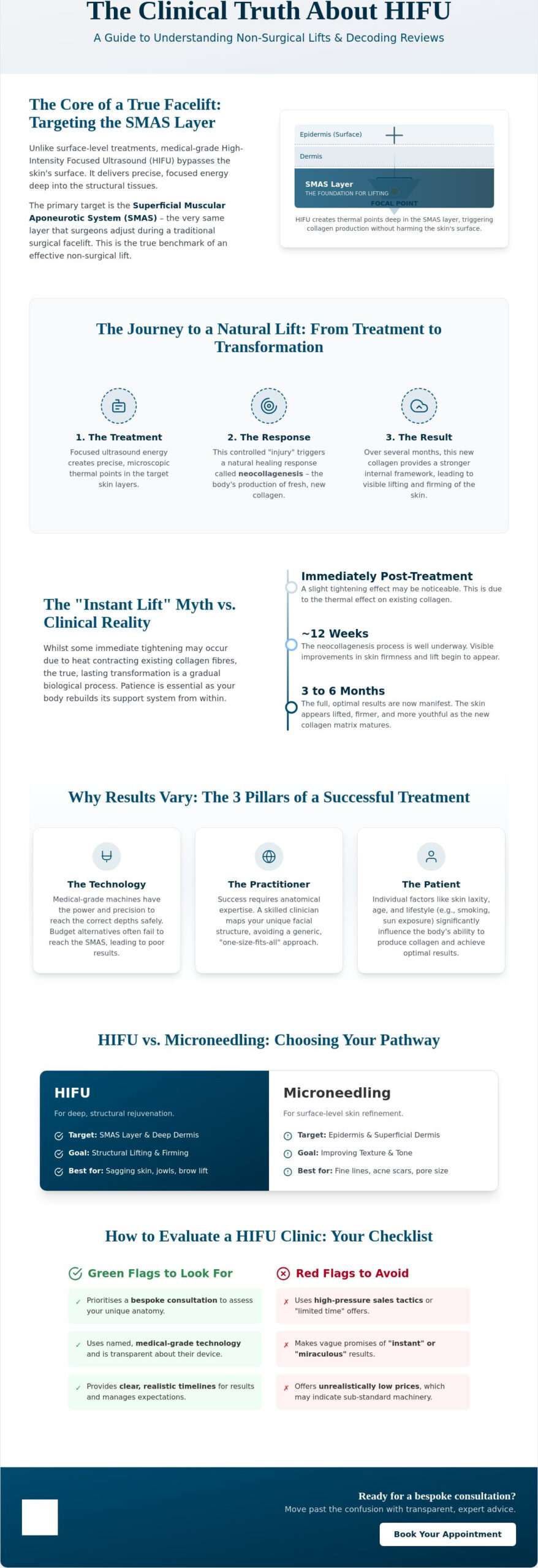
The process works by creating microscopic thermal coagulation points at precise depths within the skin. This focused ultrasound energy bypasses the epidermis entirely; this protects the surface whilst delivering heat to the foundational layers. This controlled “injury” triggers neocollagenesis, a natural biological response where the body produces fresh, high-quality collagen. Over time, this results in a structural firmness that topical creams simply cannot replicate.
The “Instant Lift” myth: Managing expectations
Whilst it’s common to see a slight initial tightening due to heat-induced collagen contraction, the true transformation is a slow, biological journey. Clinical data confirms that collagen synthesis takes approximately 12 weeks to become visible. Most patients who leave a “good” review are those who understood this timeline and waited 3 to 6 months for the full effects to manifest. Patience is essential; you’re waiting for your body to rebuild its own support system from the inside out.
Why HIFU Results Vary: The Science Behind the Success Stories
If you have spent any time browsing through hifu reviews, you’ve likely noticed a significant spectrum of experiences. Some patients report a transformative “miracle lift” whilst others feel their results were barely perceptible. This variance isn’t a matter of luck; it’s a direct consequence of biological response, lifestyle habits, and technical precision. A successful outcome depends on the body’s ability to heal and the practitioner’s ability to map the face accurately.
Technical precision involves using specific transducer depths, typically ranging from 1.5mm to 4.5mm. Each depth serves a unique purpose. The 4.5mm transducer reaches the SMAS layer to provide structural lifting, whilst the shallower depths focus on skin texture and fine lines. If a practitioner uses a generic, one-size-fits-all approach, the energy may not reach the intended target. This is why a bespoke consultation is often cited as the most critical factor in positive reviews. It ensures the treatment is tailored to your specific facial anatomy.
Your lifestyle also plays a silent but pivotal role in how your skin responds. Smoking and excessive sun exposure are the primary culprits in collagen degradation. These factors slow down the production of new collagen fibres, making it harder for the skin to “bounce back” after the procedure. A body that is well-hydrated and supported by a healthy immune system will always yield superior results during the remodelling phase.
The ideal candidate for a 5-star result
The “sweet spot” for HIFU is usually mild to moderate skin laxity. According to a clinical study on HIFU effectiveness, patients within this profile show the most consistent improvement in jawline definition and cheek lift. If there is excessive volume loss or very advanced sagging, we might suggest a combined approach with other modalities. A healthy immune system is vital, as it manages the inflammatory response that triggers the tightening effect.
Common complaints and how they are avoided
The “no result” review is almost always a case of poor patient selection. If the skin is too heavy or too thin, HIFU might not be the most effective tool in the kit. Concerns about “unbearable pain” usually stem from outdated technology. Modern, medical-grade systems are much more comfortable, offering a manageable sensation rather than an ordeal. Finally, the fear of “fat loss” is mitigated through expert mapping. By precisely targeting the correct layers, we preserve the youthful volume that keeps your face looking radiant and full.
HIFU vs Alternative Rejuvenation: Comparing Patient Satisfaction
Deciding on the right aesthetic path often feels like a puzzle. When you read various hifu reviews, the comparison is frequently made to surgical lifting, yet the most practical choice for many is actually between different non-surgical modalities. HIFU stands alone in its ability to target the deep structural layers of the face. If you are exploring the options for Skin Tightening London clinics provide, you’ll find that whilst microneedling excels at refining the surface, it cannot reach the foundational SMAS layer that ultrasound energy targets so precisely.
Microneedling creates thousands of tiny channels to stimulate collagen in the upper dermis. This is wonderful for evening out skin tone or reducing the appearance of pores. In contrast, HIFU works from the inside out. A comparative study of HIFU devices indicates that the depth of ultrasound energy is what truly drives the lifting effect. Choosing between them isn’t about which is “better,” but about which layer of your skin requires the most attention. For deep-seated laxity around the jawline, ultrasound remains the gold standard.
HIFU vs Plasma Pen: Which review should you trust?
Plasma Pen Fibroblast is often the preferred choice for very specific, small areas like the eyelids or fine lines around the mouth. It delivers exceptional tightening but requires a commitment to downtime, as the skin will display small crusts for 7 to 10 days. HIFU offers a different lifestyle benefit; it provides a full-face lift with zero downtime. For patients in their 40s or 50s looking for a comprehensive jawline and brow refresh, HIFU often represents a better return on investment because it addresses the whole face in a single, comfortable session without social interruption.
Combining treatments for superior outcomes
The most enthusiastic hifu reviews often come from those who treat their skin as a complete ecosystem. We’ve seen remarkable results when combining ultrasound lifting with Botox injections to smooth dynamic lines whilst the deeper tissue tightens. Preparing the skin with a Hydro2Facial ensures the canvas is hydrated and healthy, which is essential for Achieving Radiance in London. There is also a beautiful synergy between Caci Synergy muscle toning and HIFU skin tightening; one lifts the muscle whilst the other firms the skin, creating a truly bespoke, non-surgical transformation.
Reading Between the Lines: How to Evaluate a HIFU Clinic in London
Navigating the London aesthetic scene requires a discerning eye and a healthy dose of scepticism. When you filter through hifu reviews, the price point often becomes a focal point, yet it’s frequently the most misleading metric. In North London especially, the distinction between a high-end clinical centre and a high-street salon often comes down to the calibre of technology used. Whilst the allure of a discount is tempting, the long-term value of a treatment performed with medical-grade ultrasound technology far outweighs the initial saving.
Medical-grade certification is non-negotiable. High-quality devices represent a significant investment for a clinic, often costing tens of thousands of pounds to ensure safety and precision. If a treatment is suspiciously inexpensive, it likely utilises a lower-grade, non-certified device. These machines often lack the power to target the SMAS layer effectively, which is why “no result” testimonials are so common in budget settings. A reputable clinic prioritises clinical efficacy over high-volume turnover. Many clients who visit us for skin lifting also ask about ingrown hair removal London specialists recommend, as laser-based solutions address skin irritation and post-inflammatory hyperpigmentation that can affect the overall quality and clarity of the skin.
The consultation process should always be more thorough than the treatment itself. It’s during this time that a practitioner assesses your skin’s unique architecture. If you’re looking for a clinic that prioritises clinical precision over marketing promises, we invite you to explore our approach to bespoke HIFU treatments in North London. A professional environment will always feel more like a consultation than a sales pitch.
The 5-point checklist for choosing your practitioner
Before booking, verify that the clinic uses TGA or CE-cleared ultrasound technology to ensure the device meets rigorous safety standards. Look for “bespoke mapping” mentioned in patient testimonials; this indicates the practitioner isn’t simply following a generic grid but is tailoring the energy to your facial structure. Finally, assess the transparency of their “before and after” gallery. Real clinical results should show natural, subtle improvements in skin tension rather than heavily filtered or staged transformations.
Red flags in aesthetic reviews
Biology is rarely predictable. Beware of any clinic offering “guaranteed results,” as this is a significant red flag in an industry governed by individual healing responses. You should also be cautious of “one-size-fits-all” pricing for full-face lifting. A jawline refresh requires a different technical approach than a brow lift, and the pricing should reflect that level of customisation. Lastly, a lack of post-treatment follow-up is a clinical failure. A dedicated partner in your journey will always want to monitor your 12-week collagen synthesis progress.
Beyond the Review: The Radiant Skin House Personalised Journey
Moving from the digital world of hifu reviews into the physical reality of a clinical setting should feel like a relief rather than a risk. At our North London centre, we have carefully curated an environment that bridges the gap between medical precision and high-end hospitality. It’s a space where you’re treated as an individual with unique aesthetic goals, not just another appointment in a busy diary. Our philosophy of thoughtful transparency means we’ll always be honest about what HIFU can achieve for you, prioritising natural, refreshed outcomes that honour your original features rather than chasing an exaggerated transformation.
The foundation of our success lies in our unwavering commitment to medical-grade technology. We don’t believe in cutting corners with generic machinery, as we know that your safety and satisfaction depend on the stability and precision of the ultrasound energy delivered. This dedication to quality is what allows us to maintain our reputation as a trusted specialist in the local community; we provide the quiet luxury of knowing you’re in expert hands from the moment you walk through our doors. If you value clinical excellence wrapped in a warm, personal approach, then you’ve found the right partner for your rejuvenation journey.
Your bespoke consultation in Finchley
Every journey begins with a methodical skin analysis. We don’t just look at the surface; we assess the underlying structure to determine exactly where your skin requires the most support. If your anatomy suggests that a specific depth will yield a more significant lift, then that’s where we focus our efforts. By tailoring the ultrasound depths to your specific facial contours, we ensure the energy reaches the structural layers with absolute accuracy. Throughout the procedure, our team maintains a sense of calm confidence, ensuring you feel reassured and comfortable whilst we work to refine your jawline and brow.
Long-term care and maintenance
We understand that the biological transformation doesn’t end when you leave our centre. Because collagen synthesis is a gradual process, we implement a structured follow-up schedule to monitor your progress over the critical 12-week period. Many of our clients find that their own hifu reviews become the most positive when they commit to this holistic skin health strategy. To maintain that radiant glow, we often suggest complementary treatments like a Hydro2Facial to keep the skin hydrated and healthy. Whether it’s a one-off lift or a long-term maintenance plan, we’re dedicated to your results. Book your bespoke HIFU consultation at Radiant Skin House today.
Taking the Next Step Toward Structural Rejuvenation
The journey from initial curiosity to visible results is defined by clinical precision and informed expectations. You’ve learned that authentic hifu reviews prioritise the biological timeline of collagen synthesis over the myth of an instant fix. By focusing on the structural SMAS layer and choosing medical-grade technology, you ensure your aesthetic investment leads to a natural, refreshed appearance that honours your individuality.
We are here to act as your dedicated partner in this transformation. As specialists in non-surgical lifting, we combine advanced innovation with a warm, personal approach that puts your comfort first. Our transparent, expert-led consultations are designed to provide clarity; we ensure you understand exactly how our bespoke mapping will enhance your unique facial architecture. It’s about more than just a procedure; it’s about a long-term commitment to your skin’s health and vitality.
When you’re ready to move beyond the marketing hype and experience clinical reality, we invite you to begin your journey with us. Book Your Bespoke HIFU Consultation in North London and discover the confidence that comes from being in expert hands. Your path to a more radiant version of yourself starts with a single, thoughtful conversation.
Frequently Asked Questions
Is HIFU treatment painful according to most reviews?
Modern HIFU is generally described as a manageable sensation rather than an unbearable pain. Most current hifu reviews mention a slight tingling or a deep warmth during the procedure, which indicates the energy is reaching the correct tissue layers. Whilst older technology was sometimes associated with higher discomfort, the medical-grade devices used in professional London clinics today allow for a much more comfortable experience that doesn’t require anaesthesia.
How many HIFU sessions are actually needed for visible results?
Most patients achieve their desired outcome after a single, comprehensive session. If you have more advanced skin laxity, a second treatment might be recommended about six months after the first. This methodical approach ensures that your body has sufficient time to complete the initial collagen remodelling process before further energy is applied to the tissue.
Can HIFU cause facial fat loss or damage?
Facial fat loss is a rare complication that only occurs if the ultrasound energy is delivered at incorrect depths or settings. When a practitioner uses precise anatomical mapping, they can avoid the fat layer and target the SMAS layer instead. This clinical precision is exactly why choosing an expert clinician is more important than finding the lowest price.
What is the typical cost of HIFU in London clinics?
The cost of treatment in London varies based on the specific areas being treated and the calibre of the equipment used. Prices are typically structured according to whether you are focusing on a full-face lift, the jawline, or a targeted brow refresh. It’s always best to prioritise the quality of the technology and the expertise of the clinician over the lowest available quote to ensure your safety.
How long do the lifting effects of HIFU really last?
The lifting effects typically last between 12 and 18 months for most patients. Because the procedure stimulates your own natural collagen production, the results fade gradually as the natural ageing process continues. Many people choose to have a maintenance session every year to keep their appearance refreshed and firm whilst supporting their skin’s structural integrity.
Is there any downtime associated with HIFU facelifts?
There is absolutely no downtime associated with this procedure. You can return to your normal daily activities, including work and social events, immediately after leaving the centre. Some patients might experience slight redness or minor swelling for a few hours, but this is temporary and doesn’t require any social withdrawal or specific recovery time.
How does HIFU compare to a surgical facelift in terms of results?
HIFU provides a subtle, natural lift by tightening the structural layers without the need for incisions or general anaesthesia. Whilst it cannot replicate the dramatic transformations seen with a surgical facelift, it’s an excellent option for those looking to delay surgery. It offers a refreshed look without the significant risks, scarring, and long recovery periods associated with theatre-based procedures.
Can I have HIFU if I already have dermal fillers or Botox?
You can certainly have HIFU if you already have injectables, but the timing of your appointments is essential. It’s usually recommended to wait at least four weeks after having dermal fillers before undergoing an ultrasound lift. This ensures the filler has fully integrated into the tissue and won’t be affected by the thermal energy delivered during the treatment. For patients considering complementary treatments, our comprehensive guide to plasma pen fibroblast london procedures explains how this technology can be used alongside other non-surgical modalities to address specific areas of concern.