Skin Tag Removal · Plasma · Finchley, North London

Plasma Skin Tag Removal
in Finchley.

Precise cosmetic removal of suitable benign skin tags using plasma energy. Assessed individually, no surgical stitches, clear aftercare provided at our Finchley clinic.
Downtime

Minimal

Stitches

None

Session time

15–45 min

Healing

7–14 days

About skin tags

What are skin tags?

Skin tags are small, soft growths that hang from the surface of the skin on a narrow stalk. They are extremely common — estimates suggest around 50% of adults will develop at least one in their lifetime — and are entirely benign. They develop most frequently in areas where skin rubs against skin or clothing and are more common with age, during pregnancy, and in people with diabetes or excess weight. Although skin tags are harmless, they can cause significant irritation and self-consciousness. Tags that develop on the neck frequently catch on jewellery and clothing. Those in the underarm or groin area become irritated through friction. Tags on the eyelids or visible areas of the face and chest can cause considerable cosmetic distress even when physically painless. We treat only growths that have been assessed and appear suitable for cosmetic removal. If there is any uncertainty about the nature of a growth — whether it is changing, bleeding, or unusually pigmented — you will be referred to your GP or a dermatologist before any treatment proceeds. Client safety and correct identification are our first priority.

Common locations

  • The neck
  • Underarms
  • Upper chest and bra line
  • Groin and inner thighs
  • Beneath the breasts
  • Eyelids and eye area
The treatment

How does plasma skin tag removal work?

Plasma technology ionises the gas between the device tip and the skin surface, creating a highly controlled point of focused energy. This allows the practitioner to target the skin tag with precision while minimising unnecessary treatment of the surrounding skin. The controlled thermal effect treats the tissue of the tag, causing it to dry and detach during the healing period without the need for cutting or stitches. Depending on the size and attachment of the tag, it may be removed entirely during the appointment or may dry and fall away naturally over the following 7–14 days. Topical numbing is applied before treatment to minimise discomfort. Most clients describe the sensation as brief warmth or a mild sting. No responsible clinic can promise completely scar-free removal — any disruption to the skin carries some risk. However, plasma is one of the most precise and controlled methods available for skin tag removal without surgery.

Potential advantages

  • Precise treatment targeting only the tag
  • No surgical stitches required
  • Short appointment time per tag
  • Multiple suitable tags treated in one session
  • Limited disruption to surrounding skin
  • Straightforward aftercare with written instructions provided

Your guide

What to expect from skin tag removal at Radiant Skin House.
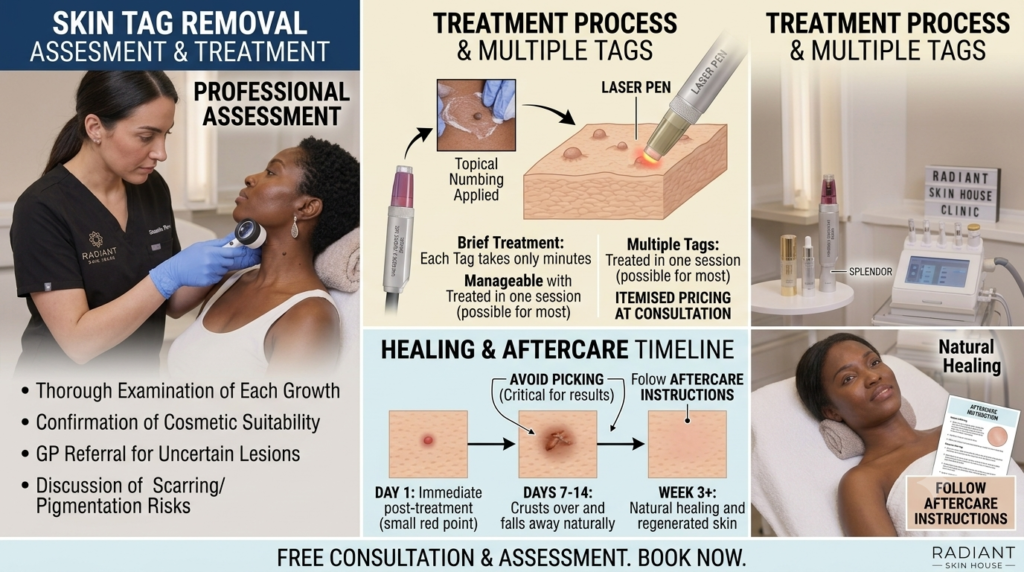
Before any treatment takes place, every new skin tag removal client at Radiant Skin House receives a thorough assessment. We examine each growth carefully, confirm it is appropriate for cosmetic treatment in an aesthetic clinic setting, and discuss the expected outcome honestly — including any risk of post-treatment pigmentation change or scarring. We do not treat growths we are not confident about, and we refer clients to their GP or dermatologist whenever there is any doubt about the nature of a lesion. For clients with multiple skin tags, we assess whether all can be treated in a single session or whether multiple shorter sessions would be preferable — particularly for tags in sensitive areas. Multiple tags treated in one session is usually possible and represents better value. We provide a clear, itemised price at consultation before any commitment is required. The treatment itself is typically brief. Each tag takes only minutes to treat. Topical numbing makes the experience manageable for the majority of clients. The treated tags will crust over and fall away naturally during the 7–14 day healing period. Following the aftercare instructions provided is the most important factor in achieving a good cosmetic outcome — particularly avoiding picking at the crust, which significantly increases the risk of scarring and pigmentation.

Healing

Aftercare following treatment

After plasma treatment, a small crust forms over the treated area. This must be kept clean and allowed to fall away naturally. Picking increases the risk of infection, scarring and pigmentation. Written aftercare instructions are provided at every appointment.

  • Keep the area clean and follow your written aftercare instructions
  • Do not pick, scratch or remove any crust — allow it to fall away naturally
  • Avoid fragranced or active skincare on the area until fully healed
  • Avoid swimming, saunas and excessive heat as instructed
  • Protect the healed area from sunlight with SPF
  • Contact the clinic if you develop increasing pain, heat, swelling or discharge
Suitability

When treatment may be postponed or declined

Treatment may not proceed immediately if any of the following apply. We will always explain our reasoning and advise on the most appropriate next step:

  • The growth has not been confidently identified as a skin tag
  • It is changing, bleeding, crusting or unusually pigmented
  • There is active infection or broken skin around the area
  • You have a history of problematic scarring or keloid formation
  • Your health or medication may affect healing
  • The location requires medical rather than cosmetic management

FAQ

Skin tag removal — questions answered

We believe in transparency — here are the answers to the questions we hear most often. If yours isn’t here, just ask.

Often yes. Suitability and pricing depend on the number, size and location of the tags. We will assess at consultation and confirm how many can be treated in a single session.
A successfully removed tag does not ordinarily regrow, but new skin tags can develop elsewhere on the body over time.
Any procedure that disrupts skin carries some risk of scarring or pigmentation change. Careful treatment and correct aftercare help reduce this risk. The likely cosmetic outcome is discussed honestly before treatment.
Some eyelid-area growths may be unsuitable for an aesthetic clinic setting due to proximity to the eye. Suitability must be assessed individually, and medical referral may be required.
Home cutting, tying or burning of skin tags is not recommended. It can cause bleeding, infection, scarring, and the growth may not actually be a skin tag. Professional assessment is always advisable.
A small crust forms over the treated area and typically falls away naturally within 7–14 days. The area beneath is usually fully healed within 3–4 weeks. Keeping the area clean and avoiding picking the crust is the most important part of aftercare.

Pricing depends on the number, size, and location of the tags to be treated. We provide a clear price at your consultation before any treatment proceeds. Multiple tags treated in one session are typically more cost-effective per tag than individual removal.

Book skin tag removal in Finchley.

19 Station Road, Finchley · Near Finchley Central Tube · Discreet consultations · Clear pricing.