
With a 95% satisfaction rate reported by the American Society for Dermatologic Surgery, it’s clear that permanent hair removal has moved from a luxury wish-list item to a clinical standard for modern grooming. If you’ve spent years dealing with the persistent sting of skin irritation from shaving or the predictable discomfort of monthly waxing, you aren’t alone. Most people seek a more permanent solution because they’re tired of the maintenance and the long-term costs associated with temporary fixes.
You deserve a routine that feels effortless; one that replaces bathroom cabinet clutter with the calm confidence of silky, radiant skin. This clinical checklist is designed to help you select a professional treatment tailored to your specific skin type and hair colour. We’ll examine the importance of medical-grade technology like multi-wavelength lasers, the impact of the new 2026 UK licensing framework, and how to find a bespoke environment where your safety is the primary focus. By understanding the technology behind the results, you can transition from temporary maintenance to a lasting, high-end solution that respects your lifestyle and your skin’s health.
Key Takeaways
- Learn how to distinguish between medical-grade and aesthetic-grade technology to ensure your hair removal treatment is both safe and effective.
- Discover why selecting the correct laser wavelength, such as Alexandrite or Nd:YAG, is essential for achieving precise results on your specific skin tone.
- Understand the vital pre-treatment protocols, including the necessity of a clinical patch test and strict sun avoidance to protect your skin’s health.
- Evaluate the long-term financial and physical benefits of professional epilation over the repetitive cycle of temporary waxing and shaving.
- Explore the standard of bespoke care provided in a luxury London environment, where clinical expertise meets personalised hospitality.
Navigating the Hair Removal Landscape: A Professional Overview
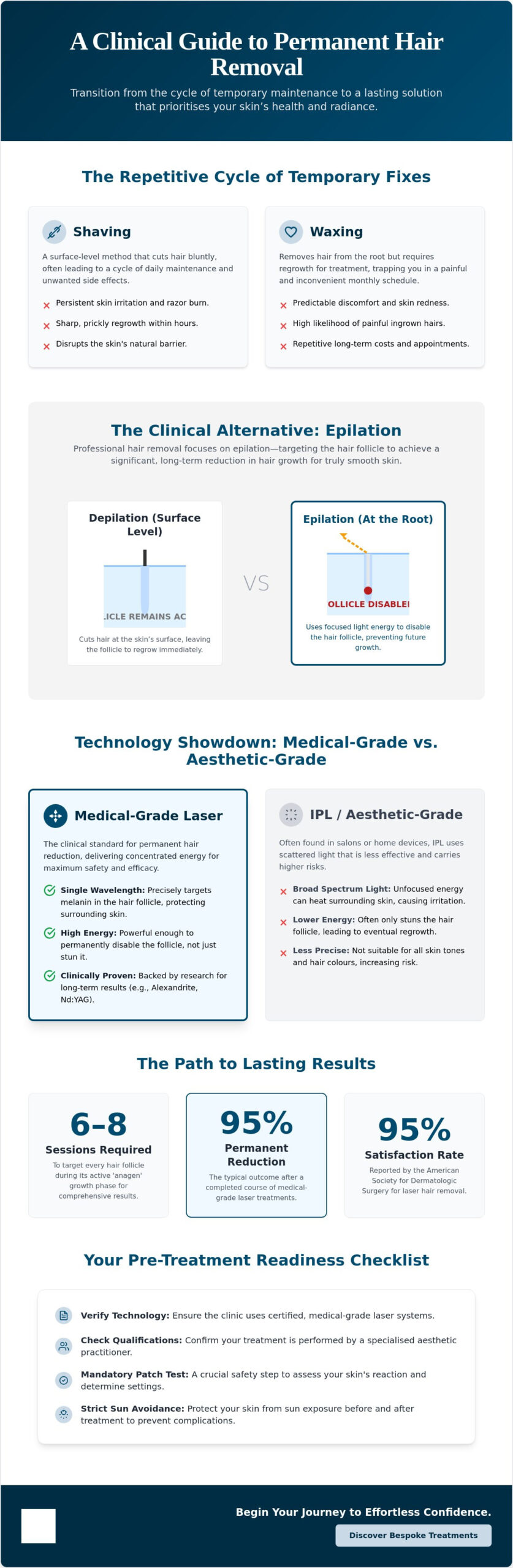
Understanding the landscape begins with a clear distinction between managing growth and eliminating it. Most traditional routines rely on depilation, which only removes hair from the surface. Whilst these methods are accessible, they often trigger a cycle of skin trauma and persistent irritation. In contrast, professional hair removal focuses on epilation, targeting the follicle itself to achieve long-term stability and significantly smoother results.
Waxing and shaving might seem cost-effective initially, but they frequently lead to folliculitis and painful ingrown hairs. These temporary fixes disrupt the skin’s natural barrier. As we move through 2026, the grooming standard has shifted toward permanent reduction. This approach prioritises skin integrity by using light-based energy to disable growth cycles without the recurring friction of a blade or the pull of hot wax.
To gain a deeper understanding of these different approaches, watch this clinical perspective from a leading dermatologist:
Depilation vs. Epilation: What Your Skin Prefers
Shaving cuts the hair at an angle, often leaving a sharp edge that can pierce the follicle wall as it regrows. Epilation, specifically through laser technology, targets the root during the anagen phase. This is the active growth stage where the hair is most receptive to treatment. Because hair doesn’t grow at the same rate, multiple sessions are required to catch every follicle in this vital stage. By consulting the history and methods of hair removal, we see that modern epilation has evolved from simple extraction to sophisticated thermal destruction. This process ensures that permanent results are actually a stable, long-term reduction in hair density that respects your skin’s natural behaviour.
The Rise of Medical-Grade Laser Technology
Precision is the hallmark of 2026 clinical standards. Unlike salon-grade Intense Pulsed Light (IPL), which uses a broad spectrum of light that can be less effective and potentially irritating, medical-grade lasers focus a single, concentrated wavelength. This allows for the precise targeting of pigment in the hair follicle without harming the surrounding skin tissue. Clinical environments provide a level of safety and efficacy that home-use devices simply cannot match. If you choose a professional setting, you’re investing in medical-grade technology that is calibrated for your specific biology by an expert practitioner. This ensures a radiant outcome that is both safe and tailored to your unique needs, moving away from a cold medical feeling toward a warm, personal experience.
The Clinical Selection Checklist: Evaluating Medical-Grade Technology
Selecting the right clinic requires looking beyond the glossy brochure and into the technical specifications of the equipment. The first item on your checklist must be the classification of the device. Medical-grade lasers operate at significantly higher energy levels than the aesthetic-grade equivalents or home IPL tools found in high street shops. This power is necessary to achieve true follicle destruction. Without sufficient energy, the hair is merely stunned, leading to regrowth rather than the permanent reduction you expect. If a clinic cannot confirm the medical-grade status of their technology, they may not be able to deliver the results promised in 2026 standards.
Transparency regarding your journey is equally vital. A reputable practitioner will be honest about the fact that most body areas require 6 to 8 sessions to see a 95% reduction. When preparing for laser hair removal, you should also verify the qualifications of the person operating the device. You want a specialised aesthetic practitioner who understands the nuances of skin behaviour, not a generalist staff member. This expertise ensures that settings are tailored to your hair density and growth cycle, providing a bespoke experience that prioritises your safety.
The Safety Checklist for Melanin-Rich Skin
For those with deeper skin tones, the Nd:YAG wavelength is a non-negotiable requirement. Unlike other lasers that might struggle to distinguish between the pigment in the hair and the pigment in the skin, the Nd:YAG has a longer wavelength. This allows it to bypass the skin’s surface and target the root directly. If a clinic suggests using a standard Alexandrite laser on melanin-rich skin without a secondary option, it’s a sign they lack the necessary precision tools. Expertly chosen settings are essential to avoid hyperpigmentation and ensure the hair removal process remains safe for every complexion.
Cooling Systems and Comfort Protocols
Modern clinical technology has refined the way we manage sensation. High-end systems now feature integrated cooling tips that protect the epidermis whilst the laser targets the root. You should be wary of any “painless” claims; professional follicle destruction involves a degree of thermal energy that you will feel. However, advanced cooling technology ensures this sensation is manageable and fleeting. If you are looking for a treatment that balances clinical efficacy with a refined, comfortable environment, you can explore our bespoke treatment options to see how we centre your comfort throughout the process.
Laser vs. The Alternatives: A Comparison Framework
Choosing between different hair removal methods often comes down to a choice between recurring maintenance and a definitive solution. Whilst a razor or a salon wax may seem budget-friendly in the short term, they represent a perpetual commitment that never addresses the root cause of growth. In contrast, clinical laser treatment offers a finite path toward total smoothness. This shift from temporary to permanent is not just about aesthetics; it is about reclaiming your time and protecting the health of your skin. If you calculate the hours spent on grooming over a five-year period, the transition to medical-grade technology becomes a logical lifestyle upgrade.
There is often a legal distinction to navigate when discussing “permanent” results. Electrolysis remains the only method legally allowed to claim permanent hair removal because it treats each follicle individually with an electric current. However, for large areas like the legs or back, this needle-by-needle approach is rarely practical. As noted in this UCSF Health overview of laser hair removal, laser technology provides a more efficient alternative by treating multiple follicles simultaneously. It achieves a stable, long-term reduction that, for most clients, is indistinguishable from total removal.
The Hidden Costs of DIY Methods
The financial impact of DIY methods is often masked by small, frequent purchases. When you add up the cost of premium razors, soothing creams, and monthly salon waxes over a decade, the total far exceeds a single course of professional laser sessions. There is also a “skin cost” to consider. Repetitive shaving and waxing often lead to scarring from chronic ingrown hairs and the persistent appearance of “strawberry legs.” For those seeking a more refined approach, professional laser hair removal for men in London has become the standard for time-poor professionals who value both precision and skin health.
Method Suitability: Matching Tech to Hair Colour
Clinical success depends heavily on the contrast between your hair and skin. Light-based therapies traditionally target the melanin in the follicle, which means that very blonde, grey, or red hair can be more challenging to treat. These hair colours often lack the pigment density required for the laser to “see” the target. In these cases, a bespoke consultation is essential to manage expectations and explore whether you are a suitable candidate. Modern devices in 2026 have improved our ability to treat a wider range of combinations, but the limitations of physics still apply. If your hair lacks pigment, traditional epilation or specialised clinical approaches may be more effective than standard light-based systems.
You should also be wary of the “Home IPL” trap. Many consumer devices operate at low energy levels that are insufficient to kill the hair bulb. Instead of removing the hair, they often just thin it or put the follicle into a temporary dormant state. This can make future professional treatments more difficult, as the weakened hair becomes harder for medical-grade lasers to detect. Choosing a professional environment from the start ensures you don’t just thin your hair, but effectively eliminate it.
Your Pre-Treatment Readiness Checklist
Achieving permanent results is a collaborative effort between your practitioner’s expertise and your own preparation. To ensure your hair removal journey is both safe and effective, following a clinical readiness protocol is essential. These steps protect your skin’s health and allow the medical-grade technology to perform with maximum precision. By preparing your skin correctly, you create the ideal environment for the laser to target the follicles without unnecessary interference.
- The Mandatory Patch Test: You must never skip the initial consultation and patch test. This clinical requirement ensures your skin reacts safely to the specific laser settings tailored for your biology.
- Strict Sun Avoidance: You should avoid direct sun exposure and tanning beds for at least four weeks prior to your session. Increased melanin in the skin from a tan can confuse the laser, leading to potential irritation or suboptimal results.
- The Shaving Rule: You must shave the treatment area 24 hours before your appointment. Whilst you need to remove the surface hair, you cannot wax or pluck for at least four weeks before treatment, as the laser requires the hair root to be present in the follicle.
- Medication Review: Certain medications, particularly those that cause photosensitivity like some antibiotics or acne treatments, can affect your suitability. Be transparent about your medical history during your consultation.
- Skin Preparation: Your skin should be free from fake tan, heavy exfoliants, and active skincare ingredients like retinoids in the days leading up to your visit.
The Importance of the Professional Consultation
During your first visit to a North London clinic, your practitioner should conduct a thorough assessment that goes beyond surface-level observations. A bespoke treatment plan is organised by evaluating your hormonal profile, hair density, and skin behaviour. This methodical approach ensures that every pulse of light is expertly chosen for your specific needs. It’s also the time to discuss the “shedding” phase; you’ll notice treated hairs falling out naturally in the weeks following your session, which is a visible sign of clinical efficacy. If you’re ready to begin this process with a dedicated partner, you can book your clinical consultation here to start your bespoke journey.
Post-Treatment Care for Radiant Results
The care you provide after your session is just as vital as the preparation. Immediately following treatment, focus on soothing the area with hydrating gels and avoiding high heat from saunas, steam rooms, or hot baths for 48 hours. Protecting the treated follicles with a high-factor SPF is non-negotiable, as this prevents pigmentation changes whilst the skin is in its refreshing recovery phase. Consistency remains the secret to total hair clearance. By adhering to your appointment schedule, you ensure that every follicle is caught in the correct growth stage, leading to the effortless, silky skin you desire. This disciplined approach ensures that your results are not only natural but lasting.
The Radiant Skin House Standard: Bespoke Hair Removal in London
Choosing a clinic for hair removal is a decision that impacts your daily comfort and your long-term skin health. At Radiant Skin House, we don’t just offer a service; we provide a clinical standard of care that prioritises your safety and your results in equal measure. Our commitment to medical-grade technology ensures that every pulse of light is delivered with the precision required to disable hair growth effectively. If you’ve been searching for a solution that moves beyond the temporary, our bespoke approach is designed to meet the high expectations of the 2026 grooming landscape.
The environment we’ve created is a sophisticated blend of clinical authority and high-end hospitality. We’ve moved away from the cold, sterile atmosphere of traditional medical centres to offer a space that feels warm, personal, and deeply private. This “quiet luxury” ensures you feel like a guest rather than just a patient. Our expert practitioners specialise in treating diverse skin tones, ensuring that whether you require an Alexandrite or an Nd:YAG wavelength, your treatment is expertly chosen for your specific biology.
Why North London Chooses Radiant Skin House
Serving the vibrant communities of Finchley, Hampstead, and Golders Green, we’ve become a trusted partner for those who value expert precision. We understand that your lifestyle is busy, which is why our tailored packages are designed to provide long-term results with minimal disruption. If you value transparency, you’ll appreciate our honest approach to session counts and expected outcomes. We combine our clinical authority with a warm touch, ensuring that your journey from the initial patch test to total skin confidence is as smooth as the results we achieve. It’s this dedication to the individual that makes us the favourite choice amongst North London’s most discerning clients.
Beyond Hair Removal: A Holistic Aesthetic Approach
We believe that skin health should be addressed at a cellular level. Whilst your primary goal might be the elimination of unwanted growth, our clinic looks at the broader health of your skin. Our hair removal services integrate seamlessly with other rejuvenation treatments, allowing us to support your skin’s radiance through every stage of your life. Being treated in a professional environment means your skin is monitored by experts who understand its behaviour. This holistic perspective ensures that your journey doesn’t just end with smoothness, but with a vibrant, healthy complexion that lasts.
Book your bespoke hair removal consultation at Radiant Skin House today and discover the confidence that comes from expert, clinical care.
Embracing the Future of Effortless Grooming
The transition from repetitive grooming to a permanent solution is a significant step toward reclaiming your time and skin health. By prioritising medical-grade technology over aesthetic-grade alternatives, you ensure that every session moves you closer to lasting results. Success depends on a bespoke approach; one that matches the correct wavelength to your specific skin tone and hair density whilst respecting your skin’s natural behaviour.
At our clinic in the heart of North London, we combine this clinical precision with a warm, personal touch. Our specialists are experts in treating all skin tones, using advanced medical-grade systems to provide a safe and radiant outcome. You’re invited to experience an environment where your comfort is as important as the efficacy of your treatment. This thoughtful approach ensures that your hair removal journey is both transparent and rewarding.
If you’re ready to leave behind the irritation of temporary methods, we’re here to guide you with calm confidence. Book Your Bespoke Laser Hair Removal Consultation today and discover the freedom of a maintenance-free lifestyle. We look forward to being your dedicated partner in achieving the silky, natural results you deserve.
Frequently Asked Questions
Is laser hair removal truly permanent?
Laser technology achieves permanent hair reduction rather than total, lifelong elimination. Advanced medical-grade systems in 2026 can achieve up to 95% reduction in hair growth by effectively disabling the follicles. Whilst the results are long-lasting, biological changes or hormonal shifts can occasionally trigger new growth over time. Most clients find that an occasional maintenance session is all that’s required to sustain their silky, radiant results.
Does laser hair removal hurt more than waxing?
Most clients report that laser treatment is significantly more comfortable than the sharp, repetitive pull of waxing. The sensation is often described as a light flick against the skin, which is fleeting and manageable. Because professional devices feature integrated cooling systems, the thermal energy is balanced by a refreshing chill. This creates a more refined experience that prioritises your comfort whilst ensuring clinical efficacy.
How many sessions of hair removal will I actually need?
A standard course of hair removal typically consists of 6 to 8 sessions to achieve optimal clearance. This schedule is necessary because the laser only targets hair in the anagen, or active growth, phase. Since your follicles don’t all grow at the same time, multiple visits ensure catch every hair at the correct stage. Some areas, such as the face or bikini line, may require a few additional sessions due to hormonal influences.
Can I get laser hair removal if I have a tan or dark skin?
You can safely undergo treatment if you have dark skin, provided the clinic utilises Nd:YAG technology. This specific wavelength bypasses the melanin in the skin to target the root directly. However, you must avoid active sun exposure or tanning beds for at least four weeks before your session. Treating tanned skin increases the risk of irritation, so we maintain a transparent safety protocol to protect your skin’s health.
What is the average cost of professional hair removal in London?
The investment for professional hair removal in London depends on the size of the area and the specific technology utilised. Larger zones like the back or full legs require more time and precision than smaller areas like the upper lip or chin. Whilst rates vary across the capital, choosing a clinic with medical-grade equipment ensures better value through superior safety and fewer required sessions. A bespoke consultation is the best way to receive a tailored quote for your needs.
What happens if I miss a scheduled laser session?
Missing an appointment can disrupt the synchronisation of your hair growth cycles. The effectiveness of the treatment relies on catching the follicles in their active stage. If you miss a window, some hairs may transition into a dormant phase before they can be treated. It’s best to re-book as quickly as possible to maintain the methodical pace of your journey and ensure you achieve total hair clearance.
Can laser hair removal help with hormonal hair growth (PCOS)?
Professional laser treatment is a highly effective management tool for the persistent hair growth often associated with PCOS. Whilst it doesn’t cure the underlying hormonal condition, it significantly reduces the density and thickness of the hair. Many clients find that a structured clinical plan provides a sense of calm confidence and reduces the need for daily maintenance. Periodic top-up sessions are usually recommended to manage any new growth effectively.
Is there any downtime after a medical-grade laser treatment?
There is virtually no downtime required after a medical-grade session. You might notice a slight redness or a mild warmth in the treated area, which typically subsides within 24 to 48 hours. We recommend avoiding high heat, such as saunas or intense exercise, for two days to allow the skin to remain refreshed and hydrated. Applying a high-factor SPF is also essential to protect the follicles as they undergo their natural shedding process.
Leave a Reply