
If you could calculate the total hours and thousands of pounds spent on a lifetime of monthly salon visits, would you still consider your regular wax a “budget-friendly” habit? Most of us have simply accepted the “waxing tax” as an inevitable part of our grooming routine, even whilst dealing with the persistent discomfort of chronic ingrown hairs and post-treatment redness. When evaluating laser hair removal vs waxing, it’s easy to focus on the immediate cost of a single appointment rather than the transformative, long-term impact on your skin health and lifestyle.
At Radiant Skin House, we believe in providing a transparent look at the clinical efficacy behind these two popular methods. This guide offers the definitive comparison you need to determine which approach provides the best value for your unique skin type and daily routine. We’ll explore the science of permanent hair reduction, the hidden financial savings of moving away from temporary fixes, and how bespoke medical-grade technology can finally eliminate “strawberry legs” for a radiant, smooth finish.
Key Takeaways
- Learn why targeting the follicle at its source provides a superior clinical outcome compared to the temporary mechanical pull of traditional waxing.
- Discover how medical-grade lasers can resolve chronic skin concerns like “strawberry legs” and ingrown hairs for a more refined skin texture.
- Evaluate the long-term financial ROI of laser hair removal vs waxing, shifting your perspective from a monthly “waxing tax” to a lasting investment.
- Understand how advanced cooling technologies ensure a comfortable and professional experience that prioritises your skin’s safety.
- Identify the best path for your lifestyle with our bespoke suitability checklist, designed to help you transition to a more effortless grooming routine.
Laser Hair Removal vs Waxing: Understanding the Fundamental Difference
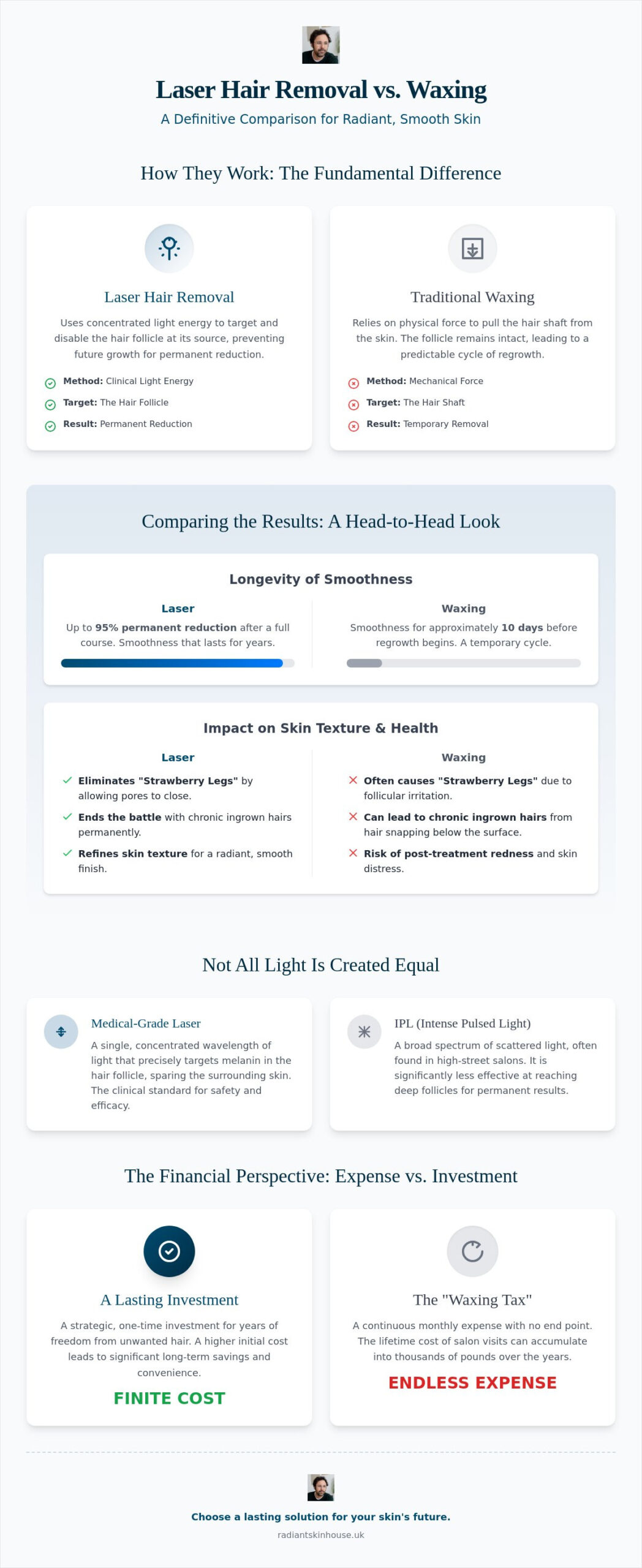
To truly understand the debate of laser hair removal vs waxing, we have to look beneath the surface of the skin. Waxing is a traditional mechanical epilation process. It relies on physical force to pull the hair shaft from the root using a sticky resin. This provides immediate smoothness, but it’s a temporary solution because the follicle remains entirely intact. The body simply begins the process of regenerating a new hair almost immediately, leading to a predictable cycle of regrowth and repeat appointments.
In contrast, the laser hair removal process uses concentrated light energy to target the hair follicle itself. Instead of a monthly cycle of removal and regrowth, laser treatments aim for permanent hair reduction by disabling the follicle’s ability to produce new hair. In a professional clinical setting, we use medical-grade technology to move beyond the endless maintenance loop of waxing toward a goal of lasting freedom from unwanted hair. This transition shifts your grooming routine from an operational monthly expense to a strategic investment in your skin’s future.
To better understand this concept, watch this helpful video:
The Science of Medical-Grade Laser vs IPL
Medical-grade lasers produce a single, concentrated wavelength of coherent light. This precision allows the energy to be absorbed by the melanin in the hair whilst sparing the surrounding skin tissue. Many high-street salons offer IPL (Intense Pulsed Light), which is often confused with laser. However, IPL uses a broad spectrum of light that scatters; this makes it significantly less effective at reaching the deep-seated follicles required for permanent reduction. Expertly chosen wavelengths, tailored to your specific position on the Fitzpatrick scale, ensure that the treatment is both safe and effective for diverse skin tones, including melanin-rich skin.
The Waxing Cycle: Why it’s a Temporary Fix
Hair grows in three distinct phases: anagen (growth), catagen (transition), and telogen (resting). Waxing only removes the hair that is currently visible above and just below the surface. It doesn’t interfere with the biological signals that trigger the next growth cycle. This creates a frustrating “regrowth period” where you must wait for hair to reach a certain length before your next appointment. If you’re tired of the “in-between” stage where skin isn’t quite smooth but isn’t ready for a wax, the shift to laser offers a more sophisticated, results-oriented alternative that respects your time and your lifestyle.
Comparing Results: Longevity, Ingrown Hairs, and Skin Texture
When we weigh up the benefits of laser hair removal vs waxing, the “smoothness window” is often the most revealing factor. Waxing provides a fleeting result; you might enjoy truly smooth skin for perhaps ten days before the first prickle of regrowth appears. This cycle forces you to live through weeks of stubble while waiting for the hair to be long enough for the next pull. Laser treatments offer a different reality. By targeting the follicle directly, most clients experience an 80% to 95% permanent reduction in hair growth after a full course. This means the window of smoothness extends from mere days to years, fundamentally changing how you relate to your skin and your morning routine.
Beyond the absence of hair, we have to consider the quality of the skin itself. Chronic waxing often leads to “strawberry legs,” where the pores appear dark and pitted due to follicular irritation. This is a common pain point for many women in North London who want to feel confident in summer dresses or at the gym. Laser technology refines the skin texture by allowing the pore to close once the hair is no longer present. It’s a clinical solution for those who find that traditional methods leave their skin looking distressed rather than radiant.
Ending the Battle with Chronic Ingrown Hairs
The mechanical nature of waxing often causes hair to snap just below the surface. When this happens, the hair can grow sideways, leading to painful, inflamed bumps and even scarring. This is why many seek ingrown hair removal london specialists to fix the damage. Laser treatments solve this problem at the source. By destroying the follicle, there’s no hair left to become trapped. This provides immense relief for sensitive areas like the bikini line or neck, where skin is thinner and more prone to reaction.
Skin Health and Pigmentation: A Clinical View
Repeated trauma from hot wax and the aggressive pulling of the skin can lead to post-inflammatory hyperpigmentation (PIH). Over time, this creates dark patches or an uneven skin tone that can be difficult to reverse. Laser treatments actually help brighten the area. They eliminate the “shadow” cast by sub-surface hair follicles, which is particularly noticeable on darker hair types. In our Finchley and Hampstead clinics, we focus on managing reactive skin through bespoke settings that prioritise safety whilst delivering visible results. When evaluating the clinical outcomes of laser hair removal vs waxing, it’s clear that the former offers a more holistic approach to skin health. If you’re ready to break the cycle of irritation, a personalised consultation can help determine the best path for your skin’s health.
The Reality of Pain and Preparation: Managing Expectations
Many clients arrive for their first consultation with a single, pressing question: how much is this going to hurt? The discomfort associated with laser hair removal vs waxing is perhaps the most debated aspect of either treatment. Whilst waxing involves a sharp, mechanical pull that causes immediate trauma to the skin surface, modern laser technology is designed to be follicle-specific. Most people describe the sensation of a medical-grade laser as a quick, warm flick of an elastic band. It’s a fleeting feeling that lacks the lingering, throbbing ache often felt after a particularly aggressive wax session.
Efficiency is another factor where the two methods diverge significantly. A Brazilian laser session in a professional clinic typically takes about 15 minutes; a thorough wax can easily stretch to 45 minutes or an hour of discomfort. If you’re a busy professional in Finchley or Hampstead, the time saved over a full course of treatment becomes a significant lifestyle benefit. You aren’t just choosing a different sensation; you’re choosing a more streamlined way to manage your personal grooming.
Is Laser Hair Removal More Painful than Waxing?
The perception of pain is subjective, but clinical feedback consistently suggests that laser becomes more comfortable as you progress through your sessions. During a wax, every appointment feels like the first because the hair is pulled from the root every single time. With laser, the hair becomes thinner and the density reduces by approximately 80% to 95% over a full course. Less hair means less energy is absorbed by the follicles, which naturally lowers the sensation. On a standard pain scale, most clients rate waxing at a 6 or 7, whilst laser typically sits at a manageable 3 or 4, especially with integrated cooling systems that soothe the skin on contact.
Preparation and Aftercare: The Clinical Protocol
The preparation requirements for these treatments are complete opposites. Waxing requires you to grow your hair out to about a quarter-inch, which often means enduring weeks of stubble that many find embarrassing. Laser requires you to shave the area 24 hours before you arrive. This ensures the light energy travels directly down the hair shaft to the follicle rather than being wasted on the surface.
Aftercare is equally vital for maintaining skin health. Whilst you can wax and head straight to the beach, laser requires a “no sun” rule for at least two weeks to prevent sensitivity. We always recommend using high-quality, soothing topicals to maintain a healthy radiance london clients expect. Proper aftercare ensures the skin remains hydrated and calm, allowing the natural results of your treatment to shine through without the redness or bumps associated with high-street waxing.
The Financial Investment: Analysing Laser Epilation Cost and Long-Term ROI
When we discuss laser hair removal vs waxing, the conversation often stalls at the initial price point. It’s helpful to reframe the “laser epilation cost” not as a recurring operational expense, but as a strategic upfront investment. Waxing is essentially a subscription to a problem you never quite solve. By choosing permanent results in 2026, you effectively opt out of the “waxing tax” that accumulates silently over years of salon visits. It’s a shift from short-term maintenance to long-term skin freedom.
Think about the numbers over a five-year horizon. A London resident visiting a salon every four weeks for a Brazilian wax will attend roughly 65 appointments in that period. When you add the cost of travel, time away from work, and the inevitable purchase of post-wax soothing oils, the total investment far exceeds a single course of medical-grade laser. Whilst the upfront commitment for laser is higher, the “time regained” is perhaps the most valuable return. You’re no longer tethered to a monthly calendar of appointments or the frustration of regrowth phases.
Upfront Price vs Lifetime Savings
It’s a common mistake to opt for the lowest quote or a “budget” IPL deal found on discount sites. These often require double the sessions because the technology isn’t powerful enough to disable the follicle permanently. In a clinical setting, we focus on technical precision. Treating multiple areas simultaneously often provides a better return on your time and financial commitment. By the two-year mark, most laser clients have already reached the “break-even” point where the cost of their sessions is fully offset by the money they’ve stopped spending on temporary fixes.
The “Waxing Tax”: Calculating the Hidden Costs
The financial burden of waxing extends well beyond the salon receipt. There’s a hidden economy of home exfoliation mitts, ingrown hair serums, and hydrating creams needed to manage the skin trauma we’ve addressed in earlier sections. Then there’s the psychological cost. The “regrowth phase” often dictates your wardrobe or your social plans. Laser is the definitive choice for the long-term thinker who values both their bank balance and their peace of mind. If you’re ready to see how this investment fits your personal lifestyle, book your bespoke consultation to begin your journey toward lasting smoothness.
Making the Choice: The Radiant Skin House Decision Framework
Deciding between laser hair removal vs waxing ultimately depends on your specific skin health and your desire for long-term freedom from maintenance. If you value a permanent reduction in grooming time and a clinical environment that prioritises safety, the transition to laser is often the most rewarding choice. However, we recognise that every individual requires a tailored approach to determine the best fit for their lifestyle. A bespoke consultation allows us to look beyond the surface and understand your unique skin story.
Consider this suitability checklist before making your final decision:
- Are you currently managing chronic ingrown hairs or skin irritation from regular waxing?
- Is your hair dark enough to contain the pigment required for laser absorption?
- Are you ready to trade a lifetime of “operational” monthly costs for a strategic one-time investment?
- Can you commit to a “shave-only” routine whilst completing your treatment course?
For many of our clients, the face is the most sensitive area of concern. We specialise in facial laser hair reduction, providing a precise and gentle solution for delicate skin that often reacts poorly to the aggressive pull of facial wax. This clinical approach ensures that even the most reactive skin can achieve a radiant, smooth finish without the risk of post-waxing breakouts or redness.
Choosing Based on Skin Tone and Hair Type
There is a persistent misconception that laser technology is unsuitable for certain skin types. Whilst older systems had limitations, modern medical-grade platforms allow us to treat melanin-rich skin safely using specific wavelengths like Nd:YAG. This precision ensures the energy bypasses the skin surface to target the follicle directly, preventing hyperpigmentation. Conversely, because the laser targets pigment, very light blonde, grey, or red hair may not respond effectively to light-based treatments. In these specific cases, traditional waxing remains a viable, albeit temporary, method. Our transparent assessment process ensures we only recommend treatments that will deliver visible, natural results.
The Clinical Advantage in North London
Choosing a professional aesthetic clinic over a standard high-street beauty salon offers a level of expertise and safety that is essential for medical-grade treatments. At Radiant Skin House, we provide a sophisticated, welcoming environment for residents in Finchley and Hampstead, as well as those travelling from nearby Potters Bar, Watford, and St Albans. We move away from the cold, sterile feel of traditional clinics toward a “quiet luxury” experience that prioritises your comfort.
The final step in resolving the laser hair removal vs waxing dilemma is a professional skin assessment. We invite you to visit our North London clinic for a personal consultation. We’ll examine your hair growth patterns and skin health to map out a bespoke plan that aligns with your lifestyle and delivers the effortless, lasting smoothness you deserve.
Step Into a New Era of Lasting Smoothness
Choosing between laser hair removal vs waxing is about more than just surface-level aesthetics; it’s a decision to prioritise your skin’s long-term health and your own daily freedom. Whilst waxing offers a quick, temporary fix, it often comes with the hidden costs of persistent irritation and a perpetual maintenance loop. Transitioning to a medical-grade solution allows you to finally resolve chronic concerns like ingrown hairs and uneven texture, replacing them with the radiant, effortless finish that only advanced technology can provide.
At Radiant Skin House, we combine clinical precision with high-end hospitality. Our expert practitioners specialise in tailoring treatments for all skin tones, ensuring every client feels heard and cared for in our welcoming North London clinics. If you’re ready to move beyond the “waxing tax” and invest in a solution that respects your lifestyle, we’re here to guide you through every step of the journey.
Book Your Bespoke Laser Consultation at Radiant Skin House and discover the confidence that comes with truly permanent results. We look forward to welcoming you to our Finchley or Golders Green locations soon to begin your transformation.
Frequently Asked Questions
Is laser hair removal more expensive than waxing in the long run?
Laser hair removal is significantly more cost-effective than waxing over a long-term period. Whilst the initial investment for a course of treatments is higher, it eliminates the need for monthly salon visits that accumulate over decades. Industry data suggests that a lifetime of waxing can cost several times more than a complete course of laser. This is especially true when you factor in the additional cost of travel and home care products.
Can I switch from waxing to laser hair removal immediately?
You can begin your transition to laser hair removal as soon as your hair has reached a specific stage in its growth cycle. It’s essential to stop waxing at least four to six weeks before your first session to ensure the hair follicle is present for the laser to target. During this waiting period, you should switch to shaving. This keeps the root intact whilst maintaining a smooth appearance before your appointment.
Does laser hair removal work on dark skin better than waxing?
When evaluating laser hair removal vs waxing, laser offers a superior clinical outcome for dark skin by addressing the root cause of irritation. Whilst waxing often leads to post-inflammatory hyperpigmentation and ingrown hairs on melanin-rich skin, modern medical-grade lasers using Nd:YAG wavelengths are specifically designed to be safe. This technology bypasses the skin surface to target the follicle without causing the trauma associated with mechanical pulling.
How many sessions of laser epilation are needed to replace waxing?
Most clients require between six and eight sessions to achieve a level of permanent hair reduction that effectively replaces the need for waxing. This number varies based on individual hair density, the area being treated, and hormonal factors. After completing a full course, most people experience an 80% to 95% reduction in growth. This means you only require occasional maintenance sessions once or twice a year to keep the skin smooth.
Is the pain of laser hair removal worse than a Hollywood wax?
Most clients report that the sensation of laser hair removal is far more manageable than the sharp, lingering pain of a Hollywood wax. Whilst waxing involves the aggressive removal of hair from the skin’s surface, medical-grade lasers use integrated cooling systems to soothe the area instantly. The feeling is often compared to a quick flick of an elastic band. This sensation subsides almost immediately after the pulse, making it a more comfortable experience.
What happens if I wax between my laser hair removal sessions?
Waxing between your laser sessions will significantly reduce the effectiveness of your treatment. Because the laser requires a hair follicle to be present in the root to work, pulling the hair out mechanically leaves the laser with no target. If you wax between appointments, you’ll likely need more sessions to achieve your desired results. We recommend shaving exclusively during your treatment course to ensure every session is productive and results-oriented.
Are there specific areas where waxing is better than laser?
Waxing is only considered a better alternative to laser in areas where the hair lacks sufficient pigment, such as very light blonde, grey, or white hair. Since lasers target melanin, they cannot effectively disable follicles that produce these lighter shades. For all other hair colours, laser provides a more refined skin texture and longer-lasting results. It’s the preferred choice for those seeking a permanent solution to unwanted hair in a clinical setting.
How much does laser epilation cost for a full body course in London?
The total investment for a full body course of laser epilation in London depends on the specific technology used and the number of sessions included in the package. Professional clinics typically offer bespoke pricing structures that provide better value when treating multiple areas simultaneously. It’s best to check with a reputable provider for a transparent breakdown of their investment options during a clinical consultation to ensure the plan fits your lifestyle.
Leave a Reply